Leaf by Leaf Border: A Designer’s Real-World Review
First Impressions: Graceful, Not Fussy
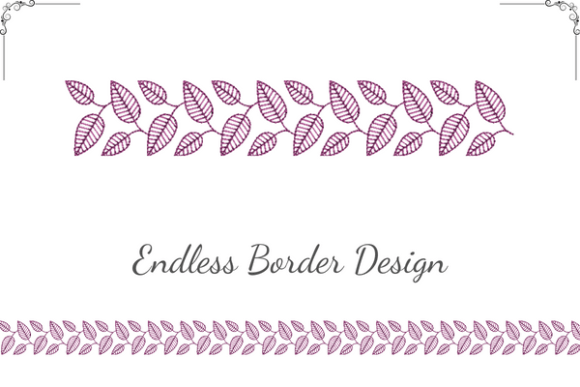
Opening Leaf by Leaf Border for the first time, I felt that quiet satisfaction you get when a design *breathes*—not too tight, not too sparse. It’s a flowing, organic border built from overlapping leaves in gentle arcs, not rigid symmetry. No florals screaming for attention, no overwrought scrolls or filler motifs. Just rhythm, repetition, and subtle variation in leaf shape and orientation. It reads as botanical but modern, delicate but confident. This isn’t a “busy” border—it’s a thoughtful frame. That makes it unusually versatile for a borders category design.
Real Project Test: A Linen Tote Bag for a Local Boutique
Last week, I prepped a custom order: five linen tote bags for a small plant shop’s opening weekend. They wanted something earthy, elegant, and unmistakably handmade—not mass-produced. I chose Leaf by Leaf Border to run along the top hem, about 4" high and 18" wide. Why? Because linen has texture and drape, and this design doesn’t fight it. The leaf shapes nestle into the weave without demanding perfect flatness. On the first test stitch, the satin stitch on leaf veins held crispness, while the fill stitch in broader sections stayed breathable—not dense enough to stiffen the fabric or cause puckering. Customers later told me the border looked “intentional, like it grew there.” That’s the kind of reaction you want from a handmade product.
Where It Shines (and Where It Asks for Care)
Leaf by Leaf Border works beautifully on stable, medium-weight fabrics: cotton tea towels, denim aprons, brushed cotton pillow covers, even midweight sweatshirt fleece. Its flow adapts well to curved edges—like the rounded corners of a baby blanket or the curved hem of a nursery wall hanging. For custom apparel, it adds quiet sophistication to the cuff of a sleeve or the back yoke of a lightweight sweater.
But here’s where judgment matters: avoid using it full-size on thin t-shirts or stretchy knits without testing. The design’s gentle curves rely on stability—if the fabric shifts under the needle, those leaf tips can blur or distort. On dark fabric, make sure your thread colors have enough contrast; pale mint or soft sage won’t read clearly on charcoal without careful selection. And on caps or curved surfaces? Scale it down significantly—or use just one repeating segment instead of the full sweep. It’s not an applique design, so don’t expect raw-edge dimensionality; it’s a refined machine embroidery design, best appreciated up close, not from across the room.
What It Does for Your Craft Business
If you’re an Etsy seller, a boutique owner, or a digital embroidery file creator, Leaf by Leaf Border quietly lifts perceived value. It reads as intentional design—not clip art. That builds customer trust, especially for personalized gifts like baby onesies or wedding guest towels. I’ve used it on embroidered patches for a local florist’s staff aprons, and the clean leaf motif reinforced their brand without shouting. It also translates well into printable mockups: the shape holds up in grayscale previews, and its moderate stitch density means it renders cleanly in low-res thumbnails—critical for online listings.
That said, don’t assume it’s “plug-and-play” for every product. On a tightly woven tea towel, I added a light tear-away stabilizer underneath and a topping of water-soluble film—just enough to keep the leaf edges sharp without adding stiffness. On a plush baby blanket, I reduced density slightly in the fill areas and used a cut-away stabilizer. These aren’t flaws in the embroidery file—they’re reminders that great design assets invite thoughtful execution.
Practical Notes Every Designer Should Check Before Stitching
- Test on scrap fabric first—especially if pairing with textured or dark materials.
- Review stitch density: Look for areas where leaves overlap closely; they may benefit from slight density reduction on delicate fabrics.
- Confirm hoop size: This design likely spans a standard 5"x7" hoop comfortably—but verify before hooping expensive fabric.
- Inspect small details: Are leaf tips sharp? Do inner veins read clearly at your intended size?
- Try black-and-white mockups: If it reads well in grayscale, it’ll hold up across varied thread palettes.
- Compare light and dark backgrounds: Some leaf shapes recede on deep tones—adjust thread accordingly.
- Use proper stabilizer: Medium-weight cut-away for knits, tear-away for stable wovens, water-soluble topping for napped or fuzzy surfaces.
- Check licensing: Confirm whether your use—whether on a finished product sold in your small shop product line or as part of a digital embroidery file bundle—is permitted.
Final Thought: A Border That Supports, Not Dominates
Leaf by Leaf Border doesn’t try to be the star—it’s the thoughtful pause between elements. That makes it ideal for holiday embroidery where sentiment matters more than flash, for baby embroidery where softness and simplicity reassure, and for commercial embroidery projects where brand subtlety builds recognition over time. It won’t wow with complexity, but it earns respect through consistency, clarity, and quiet confidence. In a market flooded with loud, trend-driven designs, Leaf by Leaf Border feels like a reliable collaborator—not a decoration, but a design decision.
Whether you’re stitching a single personalized gift, building a cohesive craft business line, or curating design assets for other makers, this border earns its place—not because it’s flashy, but because it works, thoughtfully, every time.