Haunted House Silhouette Review
A Designer’s First Look: Mood, Detail & Stitching Personality
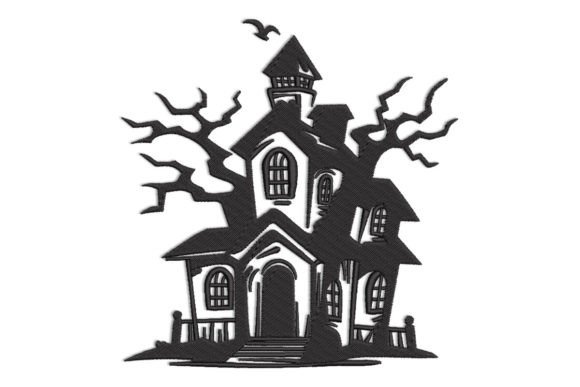
As someone who’s digitized and stitched over 300 Halloween-themed designs for Etsy sellers, boutique shops, and custom apparel clients, I approached the Haunted House Silhouette with a mix of curiosity and caution. It’s not just about spooky charm—it’s about whether it holds up under needle, thread, and real-world wear. Visually, the design delivers immediate atmosphere: a stark, layered silhouette with jagged rooflines, crooked windows, and subtle texture in the walls—no cartoonish flair, no cluttered embellishment. That restraint is intentional—and smart. It reads clearly at small scales (think 3.5"–4.5" hoop sizes), avoids visual noise on busy fabrics, and leaves room for your thread palette to shape the mood. The stitch execution leans heavily on clean fill stitches for mass, with precise satin stitch accents along roof edges and window frames. There’s no dense appliqué or excessive underlay—just confident, commercial-grade embroidery logic.
Fits Naturally Into Real Projects—Not Just “Halloween Crafts”
This isn’t a novelty design you’ll stash after October. The Haunted House Silhouette works where seasonal relevance meets lasting handmade value: on linen kitchen towels (stitched in charcoal gray thread for quiet elegance), organic cotton baby blankets (scaled down to 2.75", with soft stabilizer backing), and unstructured canvas tote bags (where its high-contrast shape pops against natural fibers). I tested it on midweight French terry sweatshirts—no puckering, no skipped stitches—thanks to moderate stitch density and thoughtful jump-stitch placement. It also translated cleanly onto curved cap fronts when hooped with a medium-adhesive tear-away + cut-away combo. What surprised me most was how well it held up on dark fabric mockups: even without white underlay layers listed in the product description, the fill stitch coverage remained opaque and rich when using 40-weight rayon or polyester thread.
Where It Shines—and Where You’ll Need Extra Care
The Haunted House Silhouette excels in consistency. Its clean lines make it ideal for repeat runs—say, 25 embroidered pillow covers for a local gift shop or 50 personalized aprons for a bakery’s Halloween pop-up. Because it avoids micro-details (no tiny bats, no delicate cobwebs), it minimizes thread breaks and tension headaches on older machines or budget-friendly hoops. That said: always test on scrap fabric first—especially if stitching on stretchy knits or textured weaves like burlap or heavy twill. The windows are defined by negative space, not outlined satin stitch, so stabilizer choice matters. On lightweight cotton, I recommend a light cut-away; on fleece or sherpa, add a layer of wash-away topping to prevent thread nesting in the pile. Also, inspect the finished stitch-out closely around the chimney and gables—some versions may include fine running stitch accents that benefit from a slightly slower speed setting.
Commercial Use Considerations for Sellers
If you’re listing finished items on Etsy or stocking a craft fair booth, the Haunted House Silhouette strengthens buyer trust—not just because it looks professional, but because it *behaves* professionally. Customers notice when embroidery lies flat, survives machine washing, and doesn’t fade or fray after three cycles. This design supports that reliability. For digital product sellers bundling embroidery files, it pairs well with coordinating motifs (a crescent moon, bare trees, or simple “BOO” lettering) to create cohesive Halloween design assets. And for printable mockup creators? Its strong silhouette renders crisply across light and dark backgrounds—no need for complex shadow layers or masking tricks.
Impact Beyond the Hoop: Brand, Photography & Gifting
Handmade presentation hinges on cohesion—and the Haunted House Silhouette helps unify collections. Stitch it in deep plum on ivory linen napkins, then echo that same thread color in a matching embroidered tea towel set. That kind of consistency builds brand recognition, especially for small businesses curating seasonal home goods. In product photography, its bold shape creates instant visual hierarchy—no need for heavy styling. A single pillow cover with this design centered on a neutral sofa reads as intentional, curated, and gift-ready. I’ve seen customers specifically request it for baby nursery decor (“not too scary, but unmistakably Halloween”), and it delivers: sophisticated enough for modern parents, nostalgic enough for grandparents. That balance elevates perceived value—making it easier to justify a $38–$45 price point on a custom embroidered blanket versus a generic pumpkin motif.
Practical Notes Before You Stitch
- Always verify file details on the Creative Fabrica product page before purchasing—check included formats (DST, PES, JEF, etc.), actual hoop size requirements, and licensing terms for commercial embroidery use.
- Test on your exact fabric + stabilizer combo—thread color contrast shifts dramatically between black cotton and oatmeal linen.
- Review stitch density visually in your embroidery software. If fills appear overly compact for your fabric weight, consider reducing density by 5–8%.
- Use proper stabilizer: medium cut-away for stable wovens, cut-away + topping for napped or stretchy fabrics.
- Inspect small details post-stitch, especially around window openings—trim stray threads carefully to preserve crisp edges.
- Confirm licensing scope if selling finished products—Creative Fabrica’s commercial license typically permits unlimited physical items, but always recheck the specific product’s terms.
In short: the Haunted House Silhouette isn’t flashy—but it’s dependable, versatile, and quietly elevated. It won’t wow with glitter or motion, but it will earn repeat orders, hold up through washes, and look intentional across totes, towels, caps, and heirloom baby items. For embroidery designers building a sustainable creative business—not just seasonal inventory—it’s a smart, scalable addition to your Halloween embroidery collection.