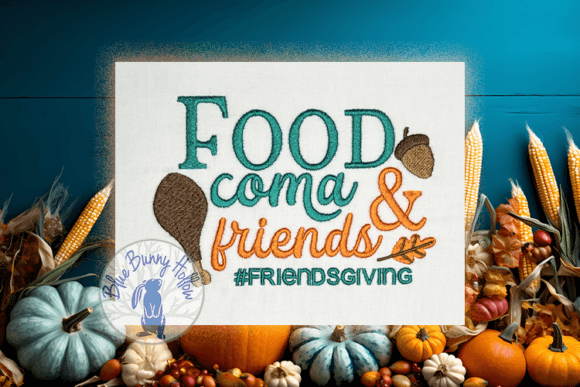
Food Coma Friends
A Warm, Playful Thanksgiving Vibe for Boutique Apparel
As an embroidery designer who’s stitched hundreds of seasonal collections for small clothing brands and Etsy sellers, my first glance at Food Coma Friends stopped me mid-scroll. It’s not just another turkey-and-pumpkin motif—it’s a refreshingly human take on Thanksgiving: cozy, slightly silly, and full of warmth. The visual personality leans playful and lighthearted, with soft curves, friendly linework, and gentle spacing between elements—no aggressive density or sharp angles. It feels intentionally unstiff: like something you’d stitch on your favorite oversized hoodie and wear while hosting friends, not posing for a corporate holiday card.
The stitching mood is relaxed but precise—ideal for machine embroidery design that needs to read clearly at 3–4 inches wide. There’s no excessive fill stitching or micro-detailing that risks bleeding on fleece or shifting on ribbed fabric. Instead, it balances clean outlines with subtle texture in key areas (think plump pie crusts or gently shaded napkins), giving it a premium handmade product feel without demanding boutique-level digitizing expertise.
How Food Coma Friends Performs Across Apparel Types
Sweatshirt embroidery: On heather grey or oatmeal French terry, Food Coma Friends shines at chest placement—centered just below the collarbone. Its moderate width and vertical rhythm keep it legible without overwhelming the garment’s relaxed silhouette. No puckering, even on thicker blends, as long as you pair it with medium-weight cutaway stabilizer.
Hoodie design & sleeve accents: For hoodies, I tested it both on the left chest and as a subtle right-sleeve motif (scaled to ~2.5"). At that size, the charm holds—the facial expressions stay readable, and the food motifs retain their whimsy. Avoid placing it across the shoulder seam unless you’re using a multi-hooping setup; the curve can distort fine lines.
Back designs & tote bags: Enlarged to 6–7", Food Coma Friends becomes a joyful anchor for back-of-hoodie statements or large tote bag panels. The composition naturally supports expansion—no awkward cropping needed. Just verify hoop size compatibility before scaling, especially if your machine maxes out at 5x7".
T-shirt embroidery & denim jackets: On soft cotton tees, use lightweight tear-away stabilizer and slightly reduced top tension—this keeps the stitching from stiffening the fabric. On denim, go heavier on stabilizer and test thread color contrast: navy thread on indigo denim reads beautifully, but light beige may disappear. The design’s open layout prevents stiffness, so it moves *with* the garment—not against it.
Cozy seasonal outfits & lifestyle photography: This is where Food Coma Friends earns its keep. Styled on cream cable-knit sweaters, sage green corduroys, or blush pink joggers, it reads as intentional, thoughtful, and quietly branded—not mass-produced. It elevates printable mockups and social media graphics because it has visual consistency: same tone, same warmth, same “I made this for *us*” energy across every piece.
Where to Use Food Coma Friends—And Where to Pause
Use it confidently on neutral sweatshirts, pastel hoodies, and dark apparel—but always test thread colors first. A warm terracotta or toasted almond works better than stark white on charcoal, and mustard gold pops cleanly on navy without glare.
Proceed with care on stretchy fabric (like cotton-Lycra blends) and curved surfaces (pockets, hems, or rounded yokes). The lettering is friendly, not tiny—so it holds up well at 3" wide, but avoid shrinking it below 2" unless you’ve verified clarity on your target fabric.
Fleece and heavy ribbed fabric demand extra stabilizer attention. Don’t skip the basting stitch step—even with medium-density stitch density, fleece can shift mid-embroidery. And if you're planning commercial embroidery runs, confirm the Creative Fabrica embroidery file includes multiple sizes and formats (PES, DST, JEF) before ordering.
Why Food Coma Friends Builds Brand Trust—Not Just Holiday Traffic
For small shop owners and Etsy sellers, seasonal designs often feel transactional. But Food Coma Friends operates differently. Its authenticity makes customers pause—not just “cute,” but *relatable*. That builds buyer trust faster than a generic “Happy Thanksgiving” script. When your boutique brand uses it consistently across sweatshirts, totes, and matching kids’ tees, it starts functioning as visual shorthand: warmth, inclusivity, low-pressure celebration.
It also supports product recognition. Unlike hyper-trendy motifs that age by December 2nd, Food Coma Friends lands somewhere between classic and current—playful enough for Gen Z shoppers, warm enough for millennial gift buyers. That duality helps your finished product stand out in crowded Etsy listings and Instagram feeds without screaming for attention.
Practical Designer Notes Before You Stitch
- Always test on scrap fabric—especially if you’re using a new blend or dye lot. Fleece behaves differently than French terry, and ribbed knits love to pucker without proper hooping technique.
- Review stabilizer choice carefully. Cutaway works best for longevity on sweatshirts; tear-away gives softer drape on tees.
- Confirm hoop size before scaling. Some versions of this Creative Fabrica embroidery file may be optimized for 4x4 hoops—others support larger formats. Check the product details page.
- Inspect stitch density visually in your embroidery software. If fills look overly dense for your fabric type, consider simplifying or adjusting underlay.
- Test on similar garment fabric, not just quilting cotton. Sweatshirt weight absorbs thread differently—and tension changes everything.
- Compare placement options: chest, sleeve, back, or pocket. Small-batch sellers often find chest + sleeve combos drive higher average order value.
- Check Creative Fabrica licensing terms before selling finished apparel. Most embroidery files allow commercial use, but verify scope—especially for print-on-demand or wholesale distribution.
At its core, Food Coma Friends isn’t just a Thanksgiving embroidery design—it’s a quiet invitation to slow down, share, and stitch something that feels like home. For apparel decorators building a boutique brand with heart, that kind of resonance is worth more than perfect stitch count. It’s the difference between a seasonal sale and a customer who saves your shop name.